In short
- A firefighting drone swarm is several aircraft sharing one picture and one plan, supervised by one operator.
- It does three jobs: it sees the fire on every side, it slows it from outside on the officer's word, and it stays on it by rotating aircraft so the work does not stop for a refill.
- Firefighters stay in command and put the fire out. The swarm goes first and tells them where to go.
- Most firefighting swarms, including Caligo C360, are in development or in trials today.
What is a firefighting drone swarm?
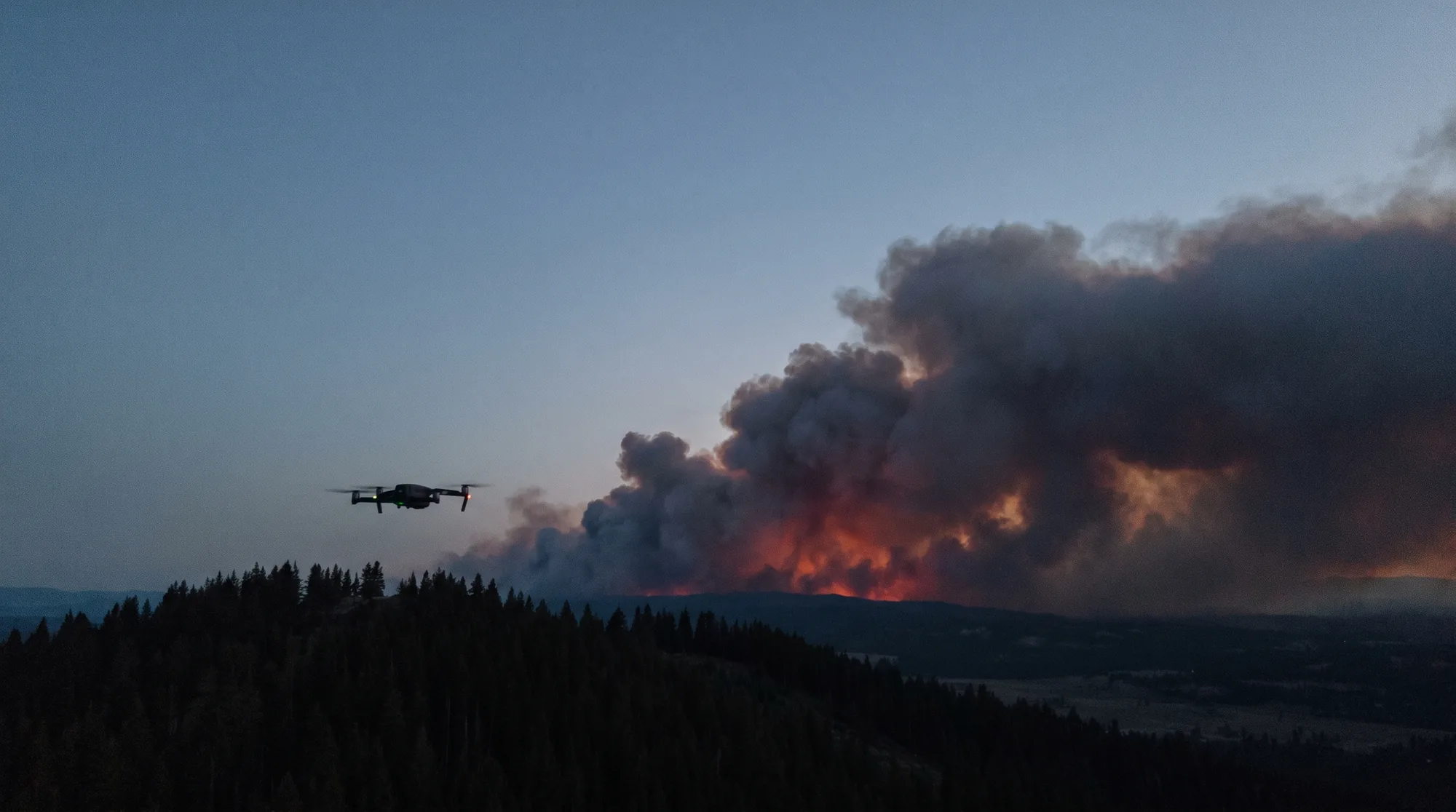
A firefighting drone swarm is a group of uncrewed aircraft that works a fire as one team. Each aircraft has a role, and all of them feed one live picture to the people in charge: where the fire is, which way it is moving and who needs reaching.
The word swarm describes how they are coordinated, not how many there are. A swarm can be a ring of a few aircraft around one building or a large fleet along a wildfire front.
Why use a swarm instead of one drone?
Because one small aircraft runs out of payload and flight time long before a fire runs out of fuel.
- Payload. A small drone carries litres of water or agent. In one study, 120 drones carrying 20 litres each on a six minute loop delivered about 400 litres a minute together2, which is in the range of a single hose line.
- Flight time. Battery drones that lift a heavy load fly for about 7 to 10 minutes, a heavy-lift drone maker told ASCE in 20251.
- Scale. In a published study of wildfire suppression, putting out about 70 metres of active front of a low-intensity fire took 60 drones carrying 30 litres each in a light wind, or 120 drones carrying 20 litres each in a stronger one, all flying in rotation2.
- Redundancy. Several small aircraft beat one big one on cost and safety. If one fails or leaves to refill, the others close the gap.
A swarm turns the payload problem into a logistics problem: bring in a full aircraft as an empty one leaves.
What does a firefighting drone swarm do?
See it. Slow it. Stay on it.
- See it. Thermal and visible cameras on several aircraft fly the walk around all four sides that every fire officer does on arrival, the 3604, and send the seat of the fire, its spread and the people a camera outside can see to the crew's phones. Long-wave infrared sees heat through most smoke3. How drones see through smoke.
- Slow it. On the officer's word, the ring cools the fire from outside and buys the crew time. The cooling stops before the crew goes in. Can drones put out fires?
- Stay on it. When an aircraft runs low it returns to the nest, its pod is swapped, and a full aircraft takes its slot. In Caligo C360 this is the Pit Stop relay.
Who controls a firefighting drone swarm?
People do. One operator supervises the swarm, a firefighter confirms every engagement, and the officer can stop it at any moment. In Caligo C360 the physical transmitter outranks the software at every instant, and a lost link sends an aircraft back rather than leaving it overhead.
The swarm gives the officer evidence; the officer decides. It never cancels or downgrades a call.
What can a firefighting drone swarm not do?
- It does not put out a burning building on its own. Firefighters do.
- It does not see through walls or closed windows, so the search inside is still the crew's.
- It does not replace crews, ladders or water supply. It goes first, not instead.
- Reaching a fire ahead of the engine depends on flight beyond the pilot's line of sight, which needs permissions that each operator has to obtain.
Where is Caligo C360 today?
Caligo C360, formerly called FireFly, is a firefighting drone swarm in development by Caligo Dynamics. A single-aircraft demonstrator (Holybro X500 v2 on PX4) flies today with thermal perception and hotspot alerting. The ring and the relay are validated in simulation, and how much fire a ring of aircraft can check has not been measured yet. Caligo C360 is Patent Pending, and Caligo Dynamics received the AWS 10,000 AIdeas Innovation Award 2026.
You can request a demo, read the FAQ, or fly a mission in the simulation.
Questions
What is a firefighting drone swarm?
A firefighting drone swarm is a group of uncrewed aircraft that works a fire as one team. The aircraft share one picture and one plan: together they see the fire, slow it from outside and stay on it, while a fire officer stays in command.
How is a swarm different from one firefighting drone?
One drone gives one view and carries little. A swarm covers every side of a building at once, hands a single live picture to the officer, and can keep working when one aircraft leaves to refill or fails, because another takes its place.
How many drones are in a firefighting swarm?
It depends on the fire and the payload. In a published study, putting out about 70 metres of active front of a low-intensity fire took 60 to 120 small drones flying in rotation, depending on wind and payload. For a building, the idea behind Caligo C360 is a small ring with a standby aircraft in rotation; the right number will come from field tests.
Who controls a firefighting drone swarm?
People do. One operator supervises the swarm, a firefighter confirms every engagement, and the officer can stop it at any moment. In Caligo C360 the physical transmitter outranks the software at every instant.
Do firefighting drone swarms exist today?
Mostly in development and trials. Several companies are testing coordinated or heavy-lift firefighting aircraft, especially for wildfire. Caligo C360 flies a single-aircraft demonstrator today, and its ring and relay are validated in simulation.
Sources
- American Society of Civil Engineers. “Automated aerial firefighting drones to provide faster responses.” Civil Engineering Source, 24 July 2025. asce.org
- Ausonio, E., Bagnerini, P. and Ghio, M. “Drone swarms in fire suppression activities.” 2020. arxiv.org
- Teledyne FLIR. “Can thermal imaging see through walls? And other common questions.” flir.com
- International Association of Fire Chiefs. “Incident commander's rules of engagement: rapidly conduct a 360 size-up of the incident.” iafc.org