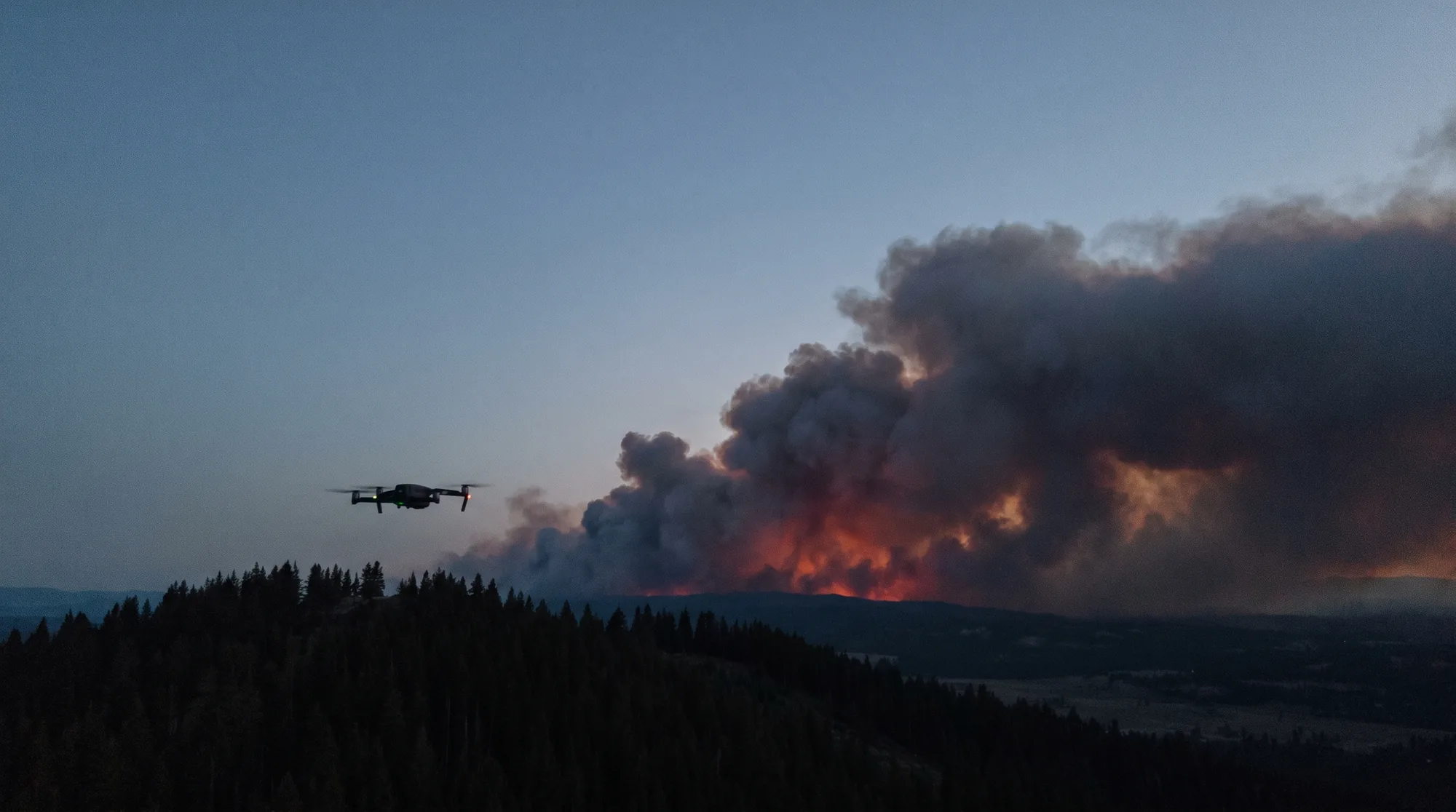
In short
- A thermal camera sees heat, not light, and long-wave infrared passes through the soot that blocks an ordinary camera1.
- It shows the seat of the fire, hot spots, the direction of spread and people in the open.
- It does not see through walls, and glass acts like a mirror for it1.
- Water in the air (fog, rain, steam and hose spray) cuts its range.
How does a drone see through smoke?
With a thermal camera. Everything warm gives off infrared radiation, and a thermal camera turns it into a picture. Smoke from a fire is mostly soot and gas, which block visible light but let long-wave infrared through, so the camera reads the heat behind the smoke1.
From the air, that view covers every side of a building at once: the walk around all four sides that a fire officer does on arrival, the 3602, can be flown before the engine stops.
What does a thermal drone show at a fire?
- The seat of the fire. The hottest point, which is where the crew needs to go.
- Spread. Walls, roofs and eaves heating up show which way the fire is moving.
- People in the open. Someone on a roof, at an open window or in a yard shows as a warm shape.
- Hot spots afterwards. Places that could rekindle once the fire is out.
What can a thermal drone not see?
- Through walls. A thermal camera reads the surface it looks at. It can show a wall heating up from a fire behind it, but not the room behind the wall1.
- Through windows. Glass acts like a mirror for long-wave infrared, so a thermal camera aimed at a window shows reflected heat, not the room1. The ordinary camera is the one that sees through a window.
- People inside. People behind walls or closed windows do not show, so the search inside is still the crew's.
What stops a thermal camera?
- Water in the air. Fog and rain scatter infrared off water droplets and can severely limit range, though thermal still sees through fog far better than an ordinary camera1. Steam and hose spray do the same.
- Even heat. In a very hot space, when smoke, walls and contents all reach similar temperatures, the picture loses contrast.
- Distance and angle. A small or distant target covers few pixels, and a shallow angle shows mostly reflections.
How does Caligo C360 see into smoke?
Caligo C360 pairs a long-wave thermal camera with a visible camera on every aircraft. Thermal finds the heat through the smoke; the visible camera reads what thermal cannot, such as the room through a window. Several aircraft give the crew every side of the building at once.
- Flying today Thermal perception and hotspot alerting on the single-aircraft demonstrator, with the detector running on the ground station and moving onboard next.
- Production design A scanning LiDAR adds the shape of the building, so heat can be placed on a 3D model.
Read what is inside the aircraft, or how a firefighting drone swarm works.
Questions
Can drones see through smoke?
Yes, if they carry a thermal camera. Long-wave infrared passes through most smoke, so a thermal drone sees the heat of the fire, hot spots and people in the open when an ordinary camera sees only grey.
Can drones see through walls?
No. A thermal camera reads the surface it looks at. It can show a wall heating up from a fire behind it, but it cannot see the room behind the wall.
Can thermal see through windows?
No. Glass acts like a mirror for long-wave infrared, so a thermal camera aimed at a window shows reflected heat, not the room. The ordinary camera is the one that sees through a window.
Can a thermal drone find people inside a burning building?
Only where a camera outside can see them: at an open window, on a roof or in the open. People behind walls or closed windows do not show, so the search inside is still the crew's.
What stops a thermal camera?
Water in the air. Fog, rain, steam and hose spray can cut its range a lot, and very dense, hot smoke lowers the contrast between the fire and everything around it.
Sources