In short
- A firefighting drone is an uncrewed aircraft that a fire service uses to see a fire, map it, or act on it.
- Most drones in service today are camera platforms. They carry thermal and visual cameras and give crews a picture they cannot get from the ground.
- Putting a fire out from a small aircraft is a payload problem: one drone carries little suppressant. A swarm that brings in a full aircraft as an empty one leaves turns that into a logistics problem.
- FireFly, from Caligo Dynamics, is built on that idea: a swarm that sees through smoke and keeps suppression continuous, with a firefighter confirming every engagement.
What is a firefighting drone?
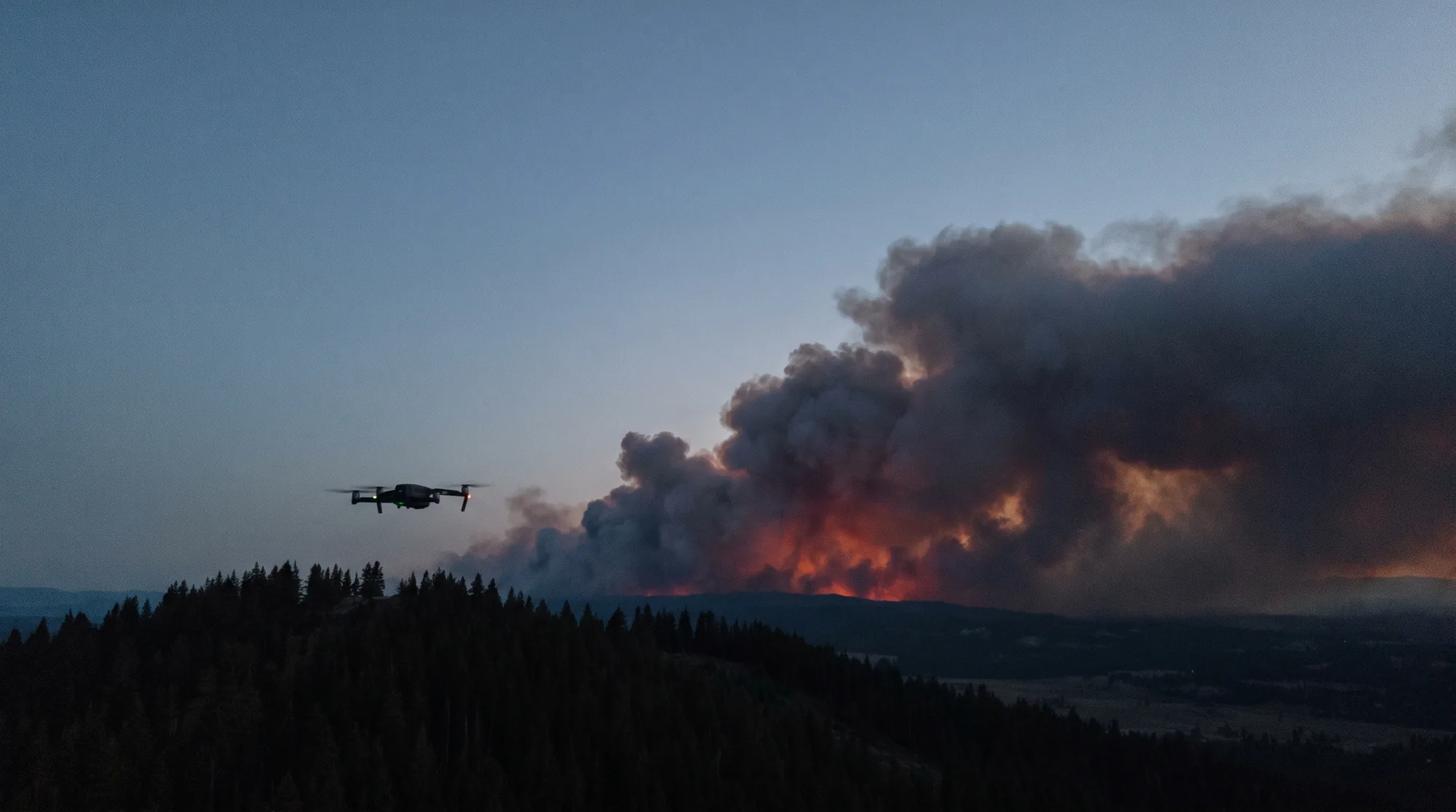
A firefighting drone is an uncrewed aircraft used by a fire service or a site operator to see a fire, map it, or act on it. The term covers very different machines, from a small quadcopter with a thermal camera to a heavy aircraft that carries a hose line or a tank of suppressant.
What they share is the job: getting eyes, and sometimes water or agent, to places that are slow or dangerous for people to reach.
What do fire services use drones for today?
Mostly for seeing. The common uses, roughly in order of how established they are:
- Size-up from above. A live overhead view of the building or the fire line in the first minutes.
- Thermal imaging. Finding the seat of the fire, hot spots and people through smoke and darkness.
- Mapping. Tracing the edge of a wildfire and the spot fires ahead of it.
- Search. Checking roofs, windows and terrain for people before crews commit.
- After the fire. Checking for remaining hot spots and documenting the scene.
- Suppression. Carrying a hose or agent to a place a ladder cannot reach. This is the newest use and the least mature.
Adoption is moving quickly. By February 2026 more than 1,000 public-safety agencies in the United States, police, fire and emergency management among them, held Federal Aviation Administration waivers for drone-as-first-responder flights. More were issued between April 2025 and February 2026 than in the previous seven years combined1.
What kinds of firefighting drone are there?
Four broad kinds. Each solves a different part of the problem.
| Kind | What it carries | What it is good for | Where it stops |
|---|---|---|---|
| Camera drone | Visual and thermal cameras | Overview, hot spots, finding people, mapping the fire's edge | It sees but cannot act |
| Tethered drone | Cameras, with power through a cable | Long overwatch from one position | It stays within reach of its cable |
| Hose or tank drone | A hose line fed from the ground, or a tank of agent | Reaching upper floors or dropping agent on a point | Tied to a hose, or empty after one tank |
| Swarm with rotation | Thermal camera, LiDAR and a suppressant pod on every aircraft | Seeing through smoke and keeping suppression continuous | In development. See where FireFly is today |
Why do the first minutes matter?
Because modern fires grow faster than crews can travel.
- In experiments by UL's Fire Safety Research Institute, rooms with modern synthetic furnishings reached flashover in under five minutes. Matching rooms with older natural furnishings took about half an hour2.
- In England, the average time from the call to the first fire engine arriving at a primary fire was 9 minutes 25 seconds in the year ending March 20263.
- A study of building fires in the Netherlands from 2018 to 2022 found that the probability of large damage rises by an average of 1% with each additional minute of response time4.
None of this is a criticism of fire crews. The fuel changed and the distance did not. An aircraft that launches the moment the call comes in can use the minutes a fire engine spends on the road.
Why can't one drone put out a fire?
Because of payload. A small aircraft can lift only a small amount of water or agent, and it empties in moments. Sending it away to refill leaves the fire unattended until it returns.
There are two ways around that. One is a bigger aircraft, or a hose fed from the ground, which gives up speed and reach. The other is rotation: several small aircraft working together, so a full one arrives as an empty one leaves.
Rotation turns a payload problem into a logistics problem. That is the idea FireFly is built on.
How does a firefighting drone swarm work?
In FireFly's design, a swarm does five things that a single aircraft cannot:
- It launches itself. The aircraft wait in a nest at the base or on the truck. The design target is under 90 seconds from dispatch to airborne.
- It sees through smoke. A long-wave thermal camera shows heat: the fire's core, hot spots and people. LiDAR maps the structure in 3D. Fused, they put structure and heat in one picture.
- It works as a ring. Five aircraft hold a ring around the fire, and each directs suppressant at the hottest point from a fixed standoff.
- It does not stop for a refill. When an aircraft runs dry it returns to the nest for a pod swap, and a standby aircraft takes its exact slot.
- A firefighter stays in command. A person confirms every engagement, the physical transmitter outranks the software at every instant, and a lost link returns the aircraft.
See the mission step by step, or what is inside the aircraft.
What should you ask any firefighting drone vendor?
Eight questions that separate a demonstration from something a fire service can rely on:
- Who confirms an engagement, and can a person override the aircraft at any instant?
- What does the aircraft do when the link drops?
- Which of your numbers were measured in flight, and which are design targets?
- Does it work at night and in smoke, or only in clear air?
- How is suppressant resupplied, and how long is the fire unattended during a refill?
- Does command depend on an internet connection?
- What is recorded on every flight, and will you share the raw records?
- What is your path to flying under our aviation authority's rules?
Our own answers to all eight are in the FAQ.
Where is FireFly today?
FireFly is in development. Our flying demonstrator is a Holybro X500 v2 on PX4, with thermal perception and hotspot alerting flying on it today. The multi-aircraft ring and relay are validated in simulation, and sustained suppression needs the larger production airframe that our raise funds.
FireFly is Patent Pending, and Caligo Dynamics received the AWS 10,000 AIdeas Innovation Award 2026.
You can request a demo, ask for the flight records, or fly a mission in the simulation.
Sources
- Electronic Frontier Foundation. Hundreds of Drone-as-First-Responder Programs Could Soon Be Launched Across the Country, July 2026. eff.org
- Kerber, S. “Analysis of Changing Residential Fire Dynamics and Its Implications on Firefighter Operational Timeframes.” Fire Technology 48 (2012). springer.com
- UK Home Office. Detailed analysis of fires and response times, England, year ending March 2026. gov.uk
- Montagna et al. “Effect of fire department response time on fire damage in the Netherlands.” Fire Safety Journal 157 (November 2025). pure.eur.nl